
In the evolving world of videography, AI mirrorless cameras have emerged as tools of choice for professionals and enthusiasts alike. Known for their lightweight design and cutting-edge technology, these cameras represent convenience and capability that traditional DSLRs struggle to match.
The heart of this evolution lies in the integration of AI, which elevates the functionalities of autofocus, subject tracking, and exposure adjustments to unprecedented levels, allowing for crisp and high-quality video production.

With many options available on the market, selecting the right mirrorless camera for videography requires careful consideration of features and intended use.
Full-frame sensors offer superior low light performance and depth of field control, which are crucial for professional-looking footage. Meanwhile, APS-C sensors strike a balance between quality and affordability.
High-resolution capabilities, such as 4K, 6K and 8K video, along with high frame rates, enable detailed and smooth slow-motion capture. Meanwhile, robust video codecs ensure that the footage retains maximum information for post-production.
Mirrorless Camera Videography Overview
- AI mirrorless cameras have transformed videography with advanced features and lightweight design.
- Choosing the appropriate camera depends on the balance between desired quality and budget considerations.
- Critical camera features include sensor size, video resolution, frame rates, and video codecs.
- Professional vloggers or videographers will have different requirements to beginners or casual users.
Choosing the Right Mirrorless Camera for Videography

In the world of videography, mirrorless cameras have become a top choice due to their compact size and high-quality video features. Let’s explore how to select the ideal model tailored to your specific videography needs and budget.
Determining Your Needs and Budget
We must first consider what our videography projects demand and how much to invest.
Beginning videographers may start with budget-friendly APS-C models such as the Fujifilm X-H2S or the Canon EOS R7, offering respectable 4K video capabilities. For professionals, full-frame cameras like the Panasonic S5 II or the Canon EOS R5 provide best-in-class video quality, often crucial for commercial shoots.
Understanding Camera Sensors
The choice between APS-C and full-frame sensors impacts video quality and depth of field.
APS-C sensors, found in cameras like the Sony a6400, offer a balance of quality and affordability, making them suitable for those looking to control costs while maintaining good video performance. Full-frame sensors, on the other hand, such as those in the Nikon Z series, yield wider dynamic range and better low-light performance, vital for professional-grade work, at a price.
Assessing Video Capabilities
We need to analyse frame rates and resolutions when assessing video capabilities.
Cameras like the Panasonic S5 II and Fujifilm X-H2S can shoot 4K video, which has become a standard in the industry. If your work demands the highest resolution, you may consider 6K or 8K options. High frame rate options—like Canon EOS R5’s 4K at 120p—allow for smooth slow-motion effects.
Exploring Autofocus Systems
The autofocus (AF) system of a camera is crucial, especially when tracking subjects in motion.
Sony cameras, renowned for their real-time tracking AF systems, ensure sharp focus throughout the filming process. The Fujifilm X-H2S also offers advanced AF capabilities, which can be a significant asset when quick focus adjustments are needed.
Considering In-Body Image Stabilization
Our final consideration should be In-Body Image Stabilization (IBIS), which reduces camera shake and is essential for handheld shooting.
Systems like those in the Canon EOS R6 Mark II and Panasonic S5 II allow the capture of more stable footage, often negating the need for a gimbal in less dynamic shooting environments. This technology is particularly beneficial for videographers who are always on the move.
Key Features in Mirrorless Cameras for Videography
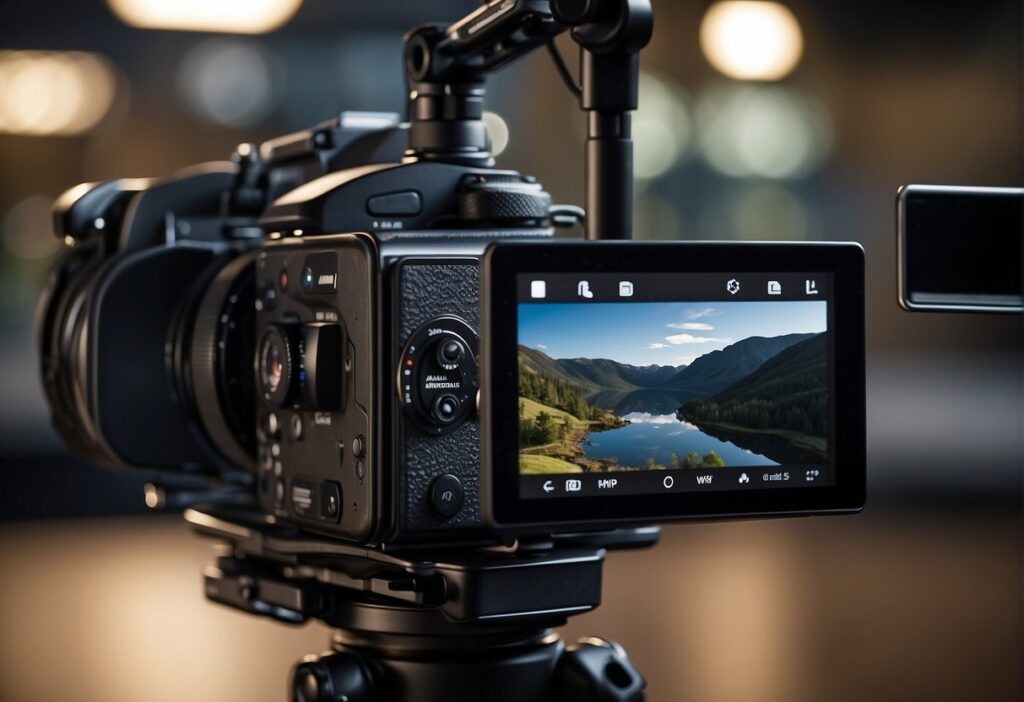
When looking at the videography capabilities of mirrorless cameras, it’s vital to prioritize several critical features, such as resolution, frame rates, and the quality of the screen and viewfinder. These components, along with memory considerations and battery life, form the bedrock of superior video performance.
Evaluating Resolution and Frame Rates
Mirrorless cameras, like the Sony A7S III and Fujifilm X-H2S, offer a range of resolutions, including 4K and sometimes even 6K – 8K, which are essential for producing high-quality video content.
The A7S III, noted for its full-frame sensor, can deliver 4K resolution at up to 120p for smooth slow-motion captures. Frame rates are crucial; higher rates are better for slow-motion footage without quality loss.
The Importance of Screen and Viewfinder Quality
The quality of a camera’s screen and viewfinder directly affects framing and focusing accuracy during recording.
Cameras such as the Sony A7 IV feature a high-resolution electronic viewfinder and touch screen, which provide crystal-clear visuals. These are indispensable for videographers who need to make quick, precise adjustments.
Memory Card Considerations: Slots and Buffer
Memory card slots and buffer capacity determine how much footage can be shot without interruption.
Cameras with dual card slots, like the Canon EOS R10, offer extended recording times and backup options. A large buffer is key for high-resolution continuous shooting, ensuring no crucial moment is missed.
Battery Life and Power Options
Battery life is a critical concern for videographers.
The Canon EOS R5 and EOS R6 Mark II stand out for their robust battery performance, making them reliable for longer shoots. Power options, such as USB charging, allow for continuous shooting by powering the camera via an external battery pack or power bank.
Lens Compatibility and Choices
Lens compatibility expands a camera’s versatility.
Mirrorless cameras, with mounts like the Olympus and Fuji systems, support a vast array of interchangeable lenses. This flexibility lets you choose from wide-angle to telephoto lenses, each suited for different video scenarios. The lens mount design of each system determines the available lens options, so compatibility is a vital factor in the best camera selection process.
Frequently Asked Questions

In this section, we explore the common inquiries surrounding AI mirrorless cameras for videography, providing you with precise and updated information relevant to 2024.
What are the top-rated mirrorless cameras for professional video recording in 2024?
For professional video recording, the Sony A7S III stands out with its full-frame sensor capable of 4K at 120p, while the Fujifilm X-H2S offers impressive 6K resolution at up to 240p. Both provide advanced features suitable for professional work.
How do built-in AI features in mirrorless cameras enhance video production?
Built-in AI features in mirrorless cameras significantly improve the video production process by enhancing autofocus capabilities, optimizing exposure settings, and providing intelligent tracking of subjects to maintain sharp focus and properly exposed shots throughout the recording.
Which is the best entry-level mirrorless camera for videography?
The Nikon Z 30 is a strong contender for the best entry-level mirrorless camera, with a 24.2-megapixel APS-C sensor, UHD 4K video capability up to 30 fps, and a fast, accurate autofocus system.
What are the benefits of using a full-frame mirrorless camera for video over other sensor sizes?
Full-frame mirrorless cameras offer superior low-light performance, greater control over depth of field, and tend to have better dynamic range compared to crop-sensor cameras. This makes them a preferred choice for professional videographers seeking the highest video quality.
Can mirrorless cameras be considered reliable for filmmaking purposes?
Yes, mirrorless cameras have become a reliable tool for filmmaking. With their advancements in video technology, robust build quality, and extensive feature sets, they are increasingly trusted by filmmakers at across the board.
How does the video quality of the latest mirrorless cameras compare to traditional video cameras?
The latest mirrorless cameras provide video quality that can rival traditional video cameras. They offer highest resolutions, faster frame rates, and advanced image processing.
They also offer the added advantage of portability and versatility in use.